.png?width=2931&height=601&name=Purple%20and%20Green%20Paper%20Music%20Event%20Banner%20(7).png "Purple and Green Paper Music Event Banner (7)")


When you need to travel 200+ miles for therapy or medical care, choosing the right transport service is critical. Standard travel options often don't meet the needs of patients requiring wheelchairs, stretchers, or medical monitoring. Here's how you can make the best choice:
- Assess Your Needs: Consult your doctor or therapist to determine medical stability, equipment requirements (oxygen, feeding tubes, etc.), and whether a medical escort is necessary.
- Check Vehicle Features: Ensure the transport vehicle is safe, accessible (wheelchair lifts, stretcher systems), and comfortable (climate control, storage for medical equipment).
- Verify Staff Qualifications: Drivers should have CPR, First Aid, and specialized training for patient safety. For complex trips, confirm the availability of additional staff like RNs or EMTs.
- Plan Your Route and Costs: Schedule rest breaks for long journeys, confirm pricing (often $1.50–$3.00 per mile), and prepare necessary documents for potential reimbursement.
- Support Your Therapy Plan: For recurring appointments, ensure the service can accommodate your schedule and specific mobility needs.
Proper planning ensures safe, reliable, and comfortable transport for long-distance medical trips.
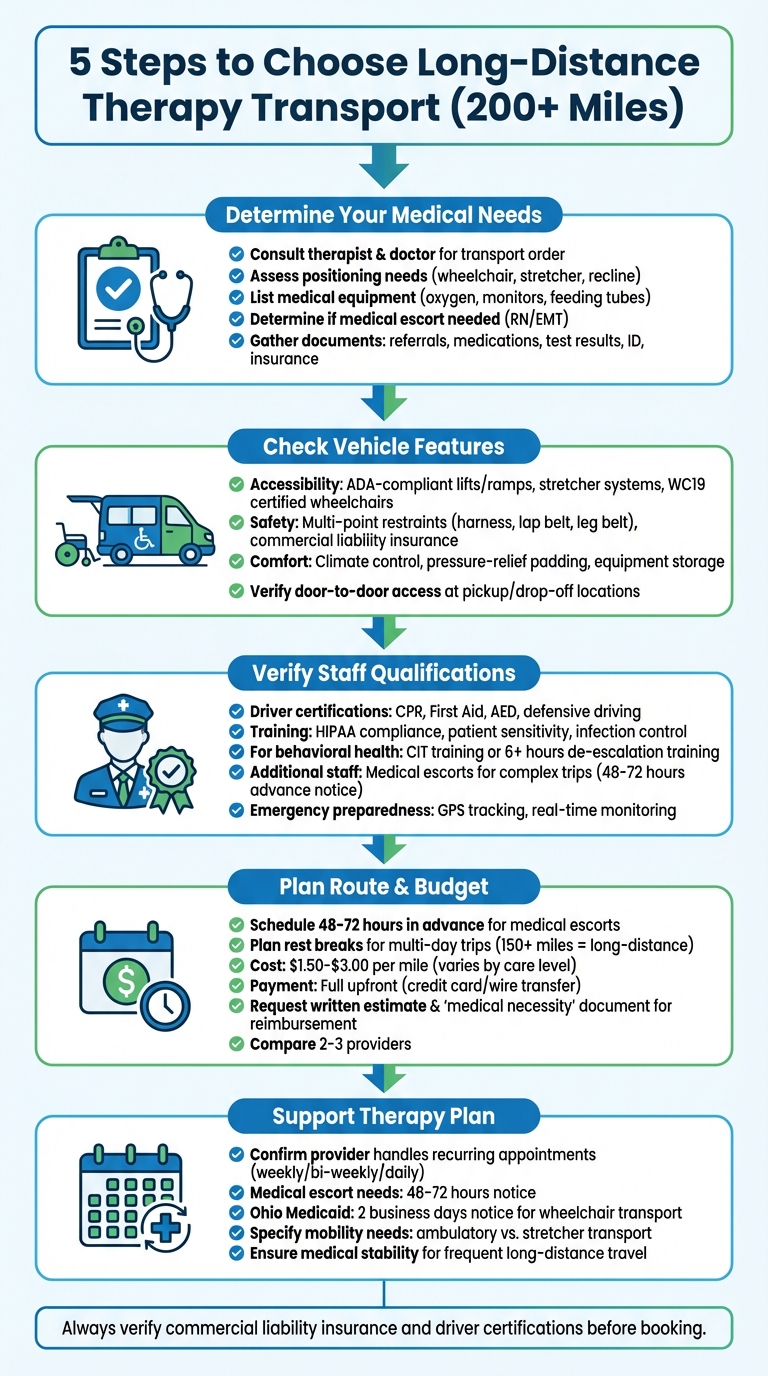
5-Step Guide to Choosing Long-Distance Medical Transport for Therapy
A better solution for long distance medical transport
Step 1: Determine Your Medical and Therapy Needs
Before planning your trip, it's essential to consult with your therapist and doctor. They can help assess your medical stability and travel requirements. Generally, patients in intensive care, on ventilators with unstable vital signs, or those with highly unstable conditions aren't suitable candidates for standard long-distance non-emergency medical transport (NEMT). Once your medical team gives the green light, focus on specific consultation points and gather necessary documents.
Talk to Your Therapist and Doctor
Start by obtaining a current transport order or referral that outlines your condition and specific travel needs. Discuss how you'll need to be positioned during transport - whether a standard wheelchair will suffice, or if you require recline support or specialized equipment like a bariatric wheelchair or bed-to-bed transfers.
If you depend on medical equipment such as oxygen, ventilators, monitors, or feeding tubes, make sure these needs are clearly noted. Additionally, clarify whether you'll need caregiver support during the trip. For longer journeys, ask your doctor about strategies to prevent pressure sores, such as frequent position changes. If your condition requires it, confirm whether a medical escort - like a Registered Nurse (RN) or Emergency Medical Technician (EMT) - should accompany you. Escorts can assist with tasks like medication administration, wound care, catheter management, or diabetic testing.
"Consulting with a transportation service and with the client's primary care physician is crucial in determining stability." - Ameritrans Online
Gather Required Documents
Once you're cleared for travel, make sure to organize all necessary paperwork. This includes your physician's referral, a list of medications and allergies, recent test results (dated within the last 30 days), government-issued photo ID, insurance cards, prior authorization forms, advance directives, and an emergency contact list. To avoid any confusion, ensure every document is clearly labeled with your full name and date of birth. Having these documents ready before booking transport not only saves time but also helps the provider accurately assess your needs and give you an appropriate cost estimate.
Step 2: Check Vehicle Access and Safety Features
When planning a long-distance journey, it’s crucial to ensure your transport is both safe and comfortable. Here’s what you need to look for before booking.
Confirm Accessibility Options
Your travel arrangements should align with your mobility needs and therapy requirements. For example, if you use a wheelchair, make sure the vehicle is ADA-compliant and equipped with heavy-duty lifts or ramps that can accommodate standard and bariatric wheelchairs. If sitting upright isn’t possible, opt for a stretcher-accessible vehicle. These vehicles typically feature ambulance-style loading systems, allowing you to remain on the stretcher while being safely secured in place with a floor-mounted locking mechanism.
For those traveling with a personal wheelchair, check if it’s WC19 certified. This certification means the wheelchair has undergone crash testing and includes four welded anchor points for secure fastening during transit.
Review Safety and Comfort Equipment
Safety and comfort are non-negotiable, especially for long trips. Look for vehicles equipped with a multi-point restraint system that includes a harness, lap belt, and leg belt. Additionally, ensure the transport provider carries a commercial general liability policy.
Comfort features like climate control, pressure-relief padding, and onboard entertainment can make a significant difference during extended journeys. Don’t forget to confirm there’s accessible storage for medical equipment, oxygen tanks, or any luggage you’ll need to bring along.
"The safest stretcher systems have a floor-mounted system that the stretcher locks into. The stretcher should have a harness, lap, and leg belt to secure the client while moving." - Ameritrans Online
Check Access at Pick-Up and Drop-Off Locations
Even the best-equipped vehicle won’t help if it can’t safely reach you. Make sure pick-up and drop-off locations are flat, low-traffic areas where ramps or lifts can be deployed without obstruction. Confirm whether the service provides true door-to-door or bedside-to-bedside assistance, meaning the driver will help with the initial transfer inside your home or facility. Carefully plan loading zones to avoid potential damage to equipment or injuries during the process.
Step 3: Review Driver Qualifications and Support Staff
Before booking, take the time to verify the training and credentials of the drivers. Ensure they are certified in CPR, First Aid, AED use, and defensive driving. They should also have clean driving records and undergo regular background and driving record checks.
Ask the company directly if they perform these checks routinely. Driver training should extend beyond the basics to include HIPAA compliance, patient and elderly sensitivity, and infection control. If the service involves transporting wheelchairs or stretchers, confirm that drivers are skilled in securing wheelchairs using floor-mounted locks and operating stretcher loading systems safely.
For trips involving behavioral health support or "protected transport", specialized training is often necessary. Look for drivers with certifications like Crisis Intervention Team (CIT) training or at least six hours of formal de-escalation training. In some state programs, mental health crisis teams may require up to 40 hours of annual training to meet specific transportation standards.
Ask About Additional Staff and Emergency Plans
The driver isn’t the only part of the equation - additional staff and emergency protocols are equally important for a safe and comfortable journey. For complex or lengthy trips, ask if extra staff can be provided. In some state-regulated programs, protected transportation mandates both a driver and an attendant in the vehicle at all times. If needed, inquire whether the service can supply a medical escort or a trained staff member to handle clinical care during the trip. This could include tasks like administering medications, managing diabetic testing, tube feedings, or even wound dressing changes.
It’s also crucial to understand the company’s emergency preparedness. Check if their vehicles are equipped with GPS tracking and real-time monitoring. Drivers should be trained to handle emergencies or sudden changes in a passenger’s condition. As Nygel Varghese, Content Producer at Tobi, explains, “A prepared driver can make all the difference if a patient feels unwell, needs medication, or is in distress due to unforeseen complications”.
These precautions not only ensure safety but also support uninterrupted care during long journeys. Lastly, verify that the company carries a commercial general liability policy, not just personal vehicle insurance, to cover any potential accidents. Provide the service with a detailed checklist of your specific needs, such as assistance with position changes to prevent pressure sores or oral medication administration, to ensure all aspects of care are addressed.
sbb-itb-a0ce227
Step 4: Plan Your Route, Schedule, and Budget
Schedule Travel Time and Rest Breaks
Double-check the date and time of your appointment to avoid any scheduling mistakes. Make sure you're in good enough health for long-distance travel, which is typically defined as trips exceeding 150 miles.
If your journey spans several days, plan ahead for hotel stays and allow time for crucial medical needs such as taking medications, diabetic testing, changing wound dressings, and repositioning to prevent pressure sores. If you’ll need professional help, like a Registered Nurse (RN) or Emergency Medical Technician (EMT), make sure to book at least 48 to 72 hours in advance.
Once your schedule is in place, review the financial details before committing to your booking.
Get Cost Details and Payment Information
Request a detailed written estimate that outlines all charges, including mileage (usually between $1.50 and $3.00 per mile), waiting times, and additional stops. The final price will depend on the level of care you require - whether it’s a basic driver, an EMT, or a Private Duty RN.
"The quoted price typically includes all standard medical care, equipment, and transportation costs. However, additional charges may apply for special equipment requirements, extra stops, or specific medical procedures during transport." - Long Distance Medical Transport FAQ
Most providers expect full payment upfront, either via credit card or wire transfer. Since many companies don’t accept direct insurance payments for long trips, ask for a "medical necessity" document that you can submit for potential reimbursement later. Keep in mind that some providers enforce a minimum distance of 150 miles to avoid extra fees for out-of-zone pickups. To get the best deal, reach out to at least two or three companies for personalized quotes, comparing their services and costs.
Pack Necessary Items for the Journey
Prepare thoroughly before departure by packing everything you’ll need. Keep prescription medications in their original labeled containers, and bring along your insurance cards, therapy plans, and medical documents. Make sure you have an updated list of all your medications and their dosages. A cell phone and charger are essential for staying in touch with family, and personal items like books, magazines, or a tablet can make the journey more comfortable. If you have specific dietary needs, let the transport company know ahead of time so they can make the necessary arrangements.
Step 5: Ensure Transport Supports Your Therapy Plan
Confirm Compatibility for Recurring Therapy Trips
When arranging transport for regular therapy appointments, make sure the provider can handle ongoing trips. Ask about their ability to accommodate a consistent schedule, whether your therapy sessions are weekly, bi-weekly, or even daily. Reliable services often use advanced routing and scheduling tools to manage repeat trips efficiently, ensuring you're always on time for your appointments.
If you require a medical escort, be aware that most services need 48–72 hours' notice to arrange this. Some providers even allow medical personnel to accompany you during therapy, which can be particularly helpful if you need assistance with medication or mobility during your session. Additionally, confirm that your medical condition is stable enough to support frequent long-distance travel. This step ties back to earlier considerations about vehicle suitability and staff qualifications.
Address Specific Mobility Needs
Once you've confirmed the provider can handle regular transport, ensure they can meet your specific mobility requirements. For those who are ambulatory, a standard wheelchair-accessible vehicle may suffice. However, if your condition necessitates lying down during transport, you'll need a stretcher van equipped with secure locking systems and space for essential medical equipment like oxygen tanks or ventilators. Many non-emergency medical transport (NEMT) trips can be handled with a standard minivan, but it's crucial to clarify your needs in advance.
Be specific about any equipment you require, such as wheelchair ramps, lifts, or oxygen support, when booking. For Ohio Medicaid recipients, most managed care providers require at least 2 business days' notice for wheelchair-accessible transport. However, urgent same-day trips may be possible with prior confirmation from the provider.
Example: ReliaWheels | NEMT for Cleveland, Ohio
Take ReliaWheels as an example. They offer long-distance therapy transport for Cleveland residents, providing both wheelchair-accessible vehicles and stretcher-equipped options. Their door-to-door service ensures smooth transitions, and their CPR-certified drivers are trained to prioritize punctuality for medical appointments. Whether you're heading to physical therapy, rehabilitation, or specialized treatment, their service caters to clients with mobility challenges or those needing stretcher transport for more delicate conditions.
Conclusion
When it comes to choosing the right therapy transport, a few key factors can make all the difference: your medical needs, vehicle safety, driver qualifications, and ongoing therapy support. For trips over 200 miles, it’s especially important to ensure you’re medically stable for extended travel and that the provider can meet your specific needs - whether that’s wheelchair accessibility, stretcher transport, or specialized care.
Make sure the service provider holds commercial general liability insurance and that their drivers are certified in CPR, First Aid, and defensive driving. The vehicle should also be equipped with essential safety features, such as floor-mounted stretcher locking systems and multi-point harnesses.
It’s a good idea to document all travel arrangements, including cost details and pickup times, and don’t hesitate to ask for proof of vehicle safety equipment if necessary. If you’re arranging transport for recurring therapy appointments, confirm that the provider can accommodate your schedule and clarify any advance notice requirements for specialized services.
FAQs
What should I consider when choosing long-distance therapy transportation?
When choosing transportation for long-distance therapy, the first step is to assess your medical needs. Make sure your condition is stable enough for non-emergency travel and consult with your doctor to confirm you won’t need advanced medical care during the trip. Take note of any specific requirements, such as mobility aids (like a wheelchair, scooter, or stretcher), oxygen, necessary medications, or even the presence of a medical professional during the journey.
You’ll also want to think about practical considerations. Look at the total distance - these services are typically for trips over 200–300 miles. Check the provider’s safety record and see if they offer helpful options like bed-to-bed transfers or wheelchair-accessible vehicles. For example, a dependable service like ReliaWheels in Cleveland, Ohio, can provide a safe and comfortable ride, especially for those needing specialized support to get to their therapy appointments.
How can I ensure the drivers and support staff are qualified for my long-distance therapy transport?
To make sure the drivers and support staff are properly qualified, ask the provider to share proof of their training and certifications. For instance, you can request to see the driver’s commercial driver’s license (CDL) and any relevant medical transport certifications, such as EMT, CPR, or training for handling wheelchairs. Reliable providers also conduct regular safety drills and emergency response training - confirm that these are current and up to standard.
It’s also important to check if the staff undergo routine background checks and complete defensive driving courses. Verify that they meet all industry requirements, such as EMT or paramedic credentials, HIPAA compliance training, and any state-mandated medical transport licenses. A trustworthy service should be transparent about their qualifications and willing to provide documentation when asked.
ReliaWheels | NEMT for Cleveland Ohio adheres to these practices, offering passengers the confidence of traveling with verified, experienced professionals who prioritize safety and reliability.
What affects the cost of long-distance medical transportation?
The price of long-distance medical transportation can vary based on a few key factors. Distance plays a major role - longer trips generally come with higher costs. The type of vehicle used, whether it's a wheelchair-accessible van or a stretcher-equipped transport, also affects pricing. On top of that, the level of medical care needed during the journey, such as specialized staff or equipment, will influence the final cost.
Other considerations include special service requirements, like door-to-door assistance, and the timing of the trip. For instance, traveling on holidays or during after-hours might come with additional charges. It’s always a good idea to ask about these specifics to ensure the service aligns with both your needs and budget.