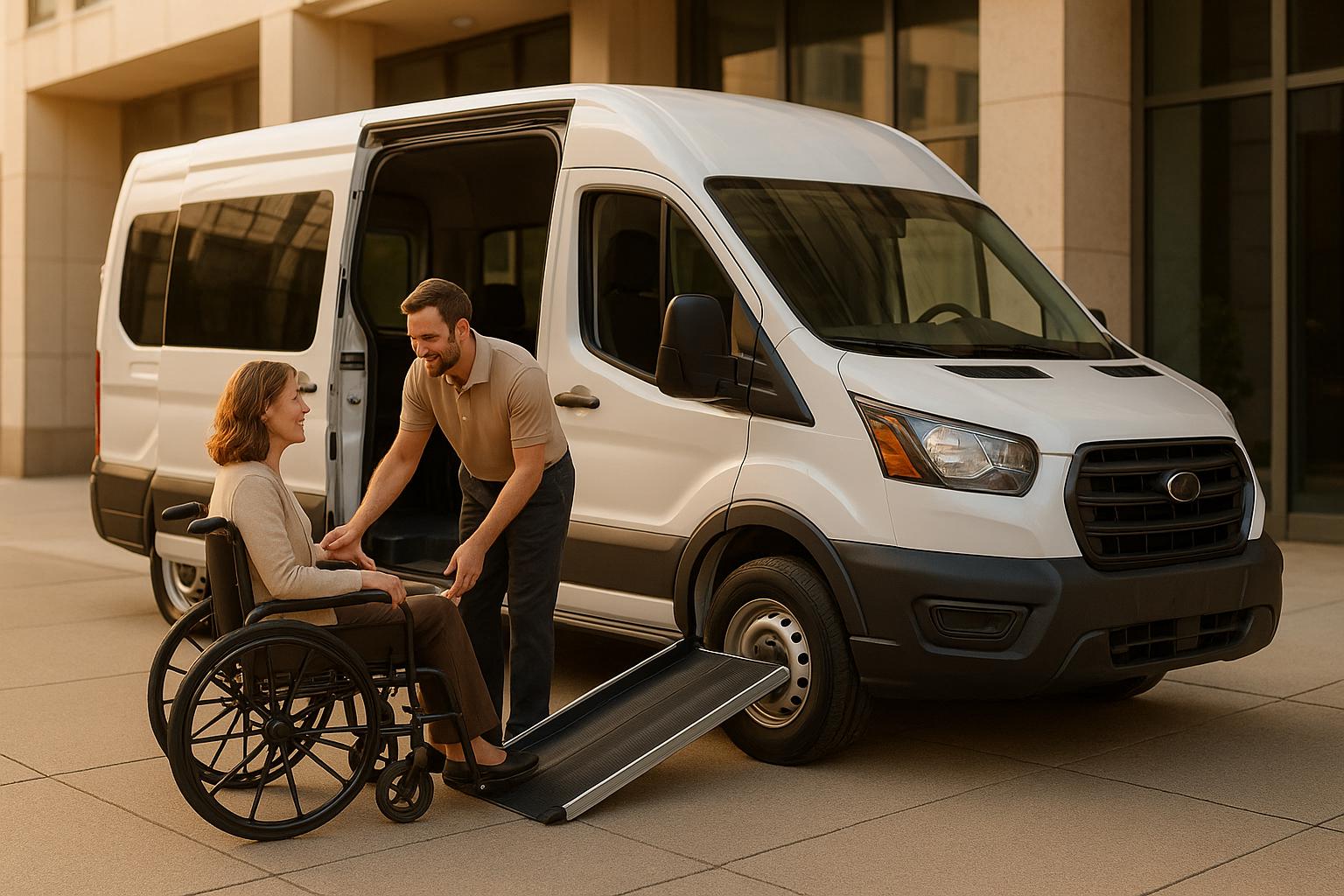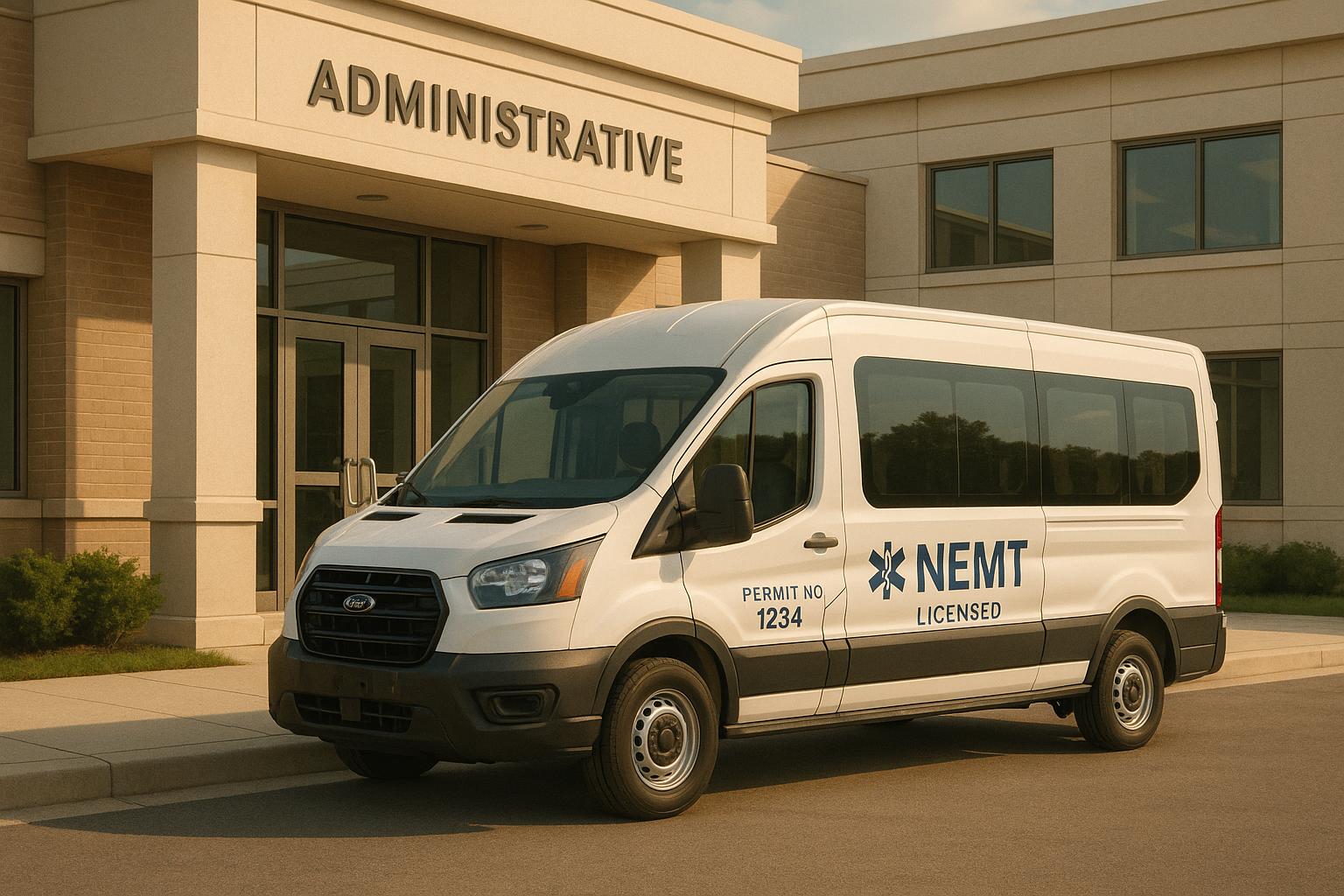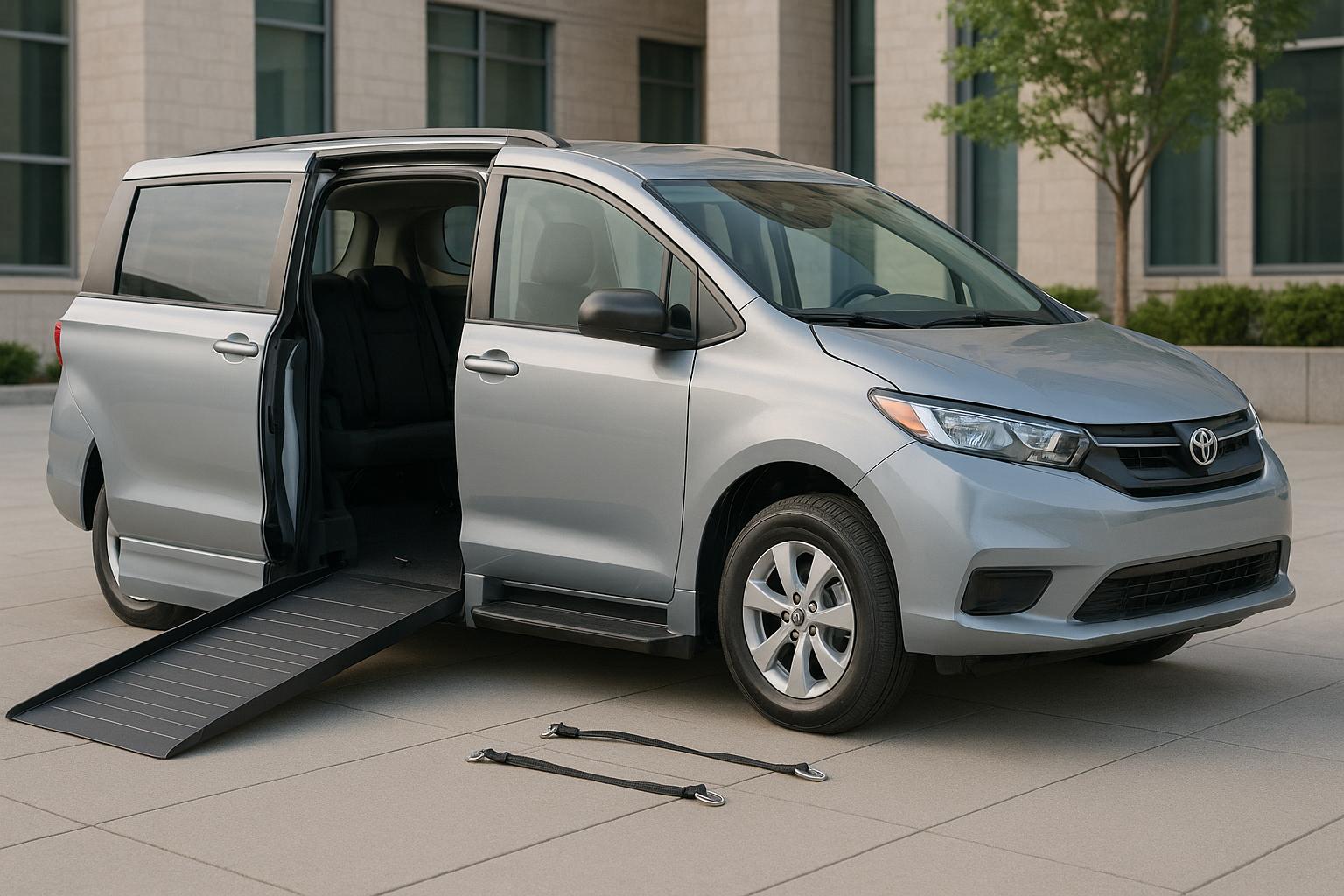

The Americans with Disabilities Act (ADA) ensures transportation services are accessible for individuals with mobility disabilities. This includes public transit, private providers, and non-emergency medical transportation (NEMT). Compliance is mandatory for vehicles purchased or leased after August 25, 1990, covering features like ramps, lifts, securement systems, and trained drivers. Providers face penalties for non-compliance, including legal liabilities and funding loss.
Key ADA requirements include:
- Vehicle Dimensions: Door heights (68 inches for large vehicles, 56 inches for smaller ones) and clear floor space for wheelchairs (30x48 inches).
- Boarding Equipment: Ramps and lifts must support at least 600 pounds, have slip-resistant surfaces, and include safety barriers.
- Securement Systems: Four-point tie-downs and passenger restraints are required for wheelchair safety.
- Driver Training: Drivers must be trained on equipment operation, securement, and emergency protocols.
Regular inspections, maintenance, and documentation are critical to meet standards and ensure passenger safety. Providers like ReliaWheels in Cleveland, Ohio, highlight the importance of reliable, accessible services for medical appointments and other essential trips. These guidelines not only fulfill legal obligations but also improve transportation access for people with disabilities.
ADA Compliance Requirements for Wheelchair-Accessible Vehicles
What ADA Compliance Means for Transportation Providers
ADA compliance ensures that transportation services are accessible to individuals with disabilities, including wheelchair users. This applies to both public and private transportation providers, requiring them to meet specific accessibility standards outlined in regulations such as the Department of Transportation's ADA rule under 49 CFR Part 37. Whether it's a large transit agency or a smaller operation, if you provide transportation services to the public, compliance isn’t optional.
These regulations extend beyond traditional wheelchairs, covering a wide range of mobility aids. Providers must accommodate these devices wherever the general public has access. For Non-Emergency Medical Transportation (NEMT) providers, compliance is critical to offering dependable service for patients needing transportation to medical appointments, dialysis, or therapy sessions.
Safety concerns regarding certain power-driven mobility devices must be based on actual risks, not assumptions or stereotypes about how individuals might use them. If accommodating a specific device isn't feasible due to legitimate safety concerns, providers are still required to explore alternative ways to offer service.
Regulatory Standards and Who Must Comply
ADA compliance for wheelchair-accessible vehicles is governed by a collaborative regulatory framework involving multiple federal agencies. The Department of Transportation (DOT) enforces the primary standards through 49 CFR Part 37, Subpart D, which sets minimum accessibility requirements. These regulations are based on guidelines created by the Access Board, which was authorized under the ADA to establish foundational accessibility standards.
Vehicles purchased or leased after a specific cutoff date must meet these standards. This marked a turning point in the industry, making accessibility a mandatory feature rather than an optional one.
Vehicle requirements vary based on size and type of service. For instance:
- Vehicles over 22 feet must have a door height of at least 68 inches and provide at least two securement locations.
- Vehicles 22 feet or under must have a minimum door height of 56 inches and at least one securement location.
| Vehicle Type | Door Height Requirement | Securement Locations |
|---|---|---|
| Over 22 feet | 68 inches minimum | At least 2 locations |
| 22 feet or under | 56 inches minimum | At least 1 location |
All vehicles must be accessible to individuals with disabilities, including wheelchair users. Demand-responsive vehicles must also meet accessibility standards unless they provide an equivalent level of service under strict regulatory criteria. This "equivalent service" rule ensures passengers with disabilities receive comparable service to other riders.
NEMT providers, while not always legally required to comply with federal ADA standards, are strongly encouraged to do so. Adopting these standards not only improves service quality but also reduces liability risks and broadens the customer base.
Common Compliance Gaps and How to Fix Them
Transportation providers often encounter recurring compliance issues, but these can be resolved with practical solutions. Addressing these gaps ensures more reliable and accessible services.
1. Inadequate Boarding Devices
One frequent issue is the lack of proper boarding equipment. Vehicles must have lifts or ramps with handrails on both sides, capable of supporting at least 600 pounds. Lift mechanisms must meet a safety factor of 6, while ramps require a factor of 3. Upgrading to compliant systems, including slip-resistant lift platforms with 1.5-inch barriers to prevent rolling, can resolve this problem. Emergency deployment systems must also function reliably, even during power outages.
2. Insufficient Interior Space
Vehicles need at least 30 by 48 inches of clear floor space for wheelchair positioning, with passageways at least 36 inches wide (32 inches for single wheelchairs, 60 inches for two to pass). Selecting vehicles with wide entries and flexible interiors can help meet these requirements. Lowered flooring adds the necessary clearance without compromising the vehicle’s structure.
3. Improper Wheelchair Securement
Securement systems are critical for passenger safety. Vehicles must feature four-point tie-down systems capable of securing wheelchairs weighing up to 600 pounds, along with passenger seat belts and shoulder harnesses. Securement areas should be located near accessible entrances to minimize transfer distances.
4. Inadequate Driver Training
Even the best equipment is ineffective without properly trained drivers. ADA regulations require drivers to undergo training on securement procedures, lift and ramp operation, and assistance techniques that maintain passenger dignity. Training should also cover emergency protocols, and providers should document completion to demonstrate compliance.
5. Door and Gate Specifications
Doors must be at least 32 inches wide and operable with no more than 5 pounds of force. Thresholds can’t exceed 0.5 inches unless beveled. These specifications ensure passengers can board independently or with minimal assistance.
6. Overlooked Reach Requirements
Passengers need to access controls and features within reach. For front approaches, objects must be no higher than 48 inches and no lower than 15 inches from the ground. For side approaches, the maximum height is 54 inches, with a minimum of 9 inches off the ground. Providers should audit vehicle interiors to ensure controls are accessible.
7. Documentation Gaps
Even if physical requirements are met, poor record-keeping can lead to compliance issues. Providers should maintain detailed records of inspections, driver training, and maintenance for lifts, ramps, and securement systems. These records not only demonstrate compliance but also help identify areas for improvement before violations occur.
ADA Customer Service & Wheelchair Securement
Vehicle Design and Accessibility Features
The design of wheelchair-accessible vehicles focuses on ensuring safe, comfortable, and secure transportation for individuals with mobility challenges. These features are not just conveniences - they're essential for creating a functional and user-friendly experience.
Boarding and Access Systems
A wheelchair-accessible vehicle isn’t complete without a reliable lift or ramp that allows for independent boarding. These systems must handle at least 600 pounds, accommodating both the wheelchair and its user. To ensure safety, lift mechanisms like pulleys and cables are built with a safety margin of at least six times their rated capacity, while ramps require a safety margin of three times.
Lift platforms include thoughtful design elements such as 1.5-inch-high barriers around the edges to prevent wheelchairs from rolling off. They also feature two handrails set between 30 and 38 inches above the ground for added stability. The platform itself must be spacious enough to fit a wheelchair measuring 30 inches by 48 inches.
Ramps, on the other hand, need to be at least 30 inches wide and long, with slip-resistant surfaces to reduce risks. When deployed at ground level, the slope cannot exceed a 1:4 ratio. The ramp surface must remain smooth, free of bumps over 1/4 inch, and any handrails installed should be continuous and sturdy.
Emergency deployment systems are another critical feature. Lifts must include backup mechanisms to prevent free-fall or sudden deployment during a power outage.
Doors also play a key role in accessibility. They need to be at least 32 inches wide, with a height of 68 inches for larger vehicles (over 22 feet) or 56 inches for smaller ones. Doors should open with minimal effort - requiring no more than 5 pounds of force - and thresholds should not exceed 0.5 inches unless beveled.
To further enhance safety, level landings at the top and bottom of boarding devices are designed to prevent water pooling. Additionally, slip-resistant surfaces throughout the boarding area reduce the likelihood of accidents.
These access features pave the way for a functional and safe interior layout.
Interior Space and Maneuverability Requirements
Inside the vehicle, space and layout are crucial for accommodating wheelchairs and other mobility devices. Each wheelchair requires a designated space measuring 30x48 inches. Aisles must be at least 36 inches wide, expanding to 60 inches when accommodating two wheelchairs, and there should be a 60-inch turning diameter for 180° rotations.
For larger vehicles, at least two securement areas are required, while smaller ones need at least one. These spaces should be located as close as possible to accessible entrances for convenience.
The interior must also account for a variety of mobility devices, from manual and power wheelchairs to electric scooters, walkers, crutches, and canes. Standards for lift platform sizes and clear floor space are designed to accommodate even the largest devices.
To ensure ease of use, all controls and emergency equipment must be within reach. For front approaches, users shouldn’t need to reach higher than 48 inches or lower than 15 inches. For side approaches, the upper limit is 54 inches, with a minimum height of 9 inches.
Slip-resistant surfaces are a must throughout the interior. Any changes in floor level greater than 0.5 inches should be smoothed out with a ramp or transition device to ensure seamless movement.
Wheelchair Securement and Safety Systems
Once boarding and interior layouts are optimized, securement systems take center stage to ensure passenger safety during transit.
Each securement area must include at least four tie-downs to anchor the wheelchair to the vehicle floor. These tie-downs are designed to secure wheelchairs weighing up to 600 pounds. A proper securement system combines these tie-downs with occupant restraints, such as seatbelts and shoulder harnesses, to protect the passenger. Securement areas should be positioned near accessible entrances to minimize the distance wheelchair users need to travel once inside.
For example, services like ReliaWheels in Cleveland, Ohio, specialize in non-emergency medical transportation using wheelchair-accessible vehicles. Their focus on securement systems ensures patients can safely travel to appointments, therapy sessions, and other destinations.
Additional safety features like emergency brakes and power-failure systems provide an extra layer of protection. Regular inspections and maintenance, along with proper documentation of tie-down ratings and seatbelt certifications, are essential for keeping vehicles compliant and safe over time.
sbb-itb-a0ce227
Safety and Emergency Features for ADA Compliance
Safety systems are essential for protecting passengers, from boarding to handling emergencies. Meeting these standards ensures vehicles comply with federal regulations while prioritizing passenger security.
Lift and Ramp Safety Mechanisms
The mechanical systems for boarding must incorporate multiple safeguards to ensure passenger safety. For instance, lift platforms must include barriers at least 1.5 inches high on both sides to prevent wheelchairs from rolling off during use. Additionally, emergency systems must have backup mechanisms to prevent rapid deployment or free-fall in case of power failure.
Load capacity is another critical factor. Ramps longer than 30 inches must support up to 600 pounds, while shorter ramps should handle at least 300 pounds. Lift mechanisms such as pulleys and cables must meet a safety factor of 6, whereas ramps require a safety factor of 3.
Ramp surfaces also need to meet specific standards. They must be slip-resistant, provide a clear width of 30 inches, and ensure that any bumps or projections do not exceed 1/4 inch in height. Handrails, when present, must be continuous and positioned 30 to 38 inches above the ramp surface. Additionally, door clearance requirements, as outlined in earlier sections, must be adhered to.
Regular testing is crucial to maintain these safety features. Transportation providers should implement schedules for load testing, inspect emergency systems, and verify slip-resistant surfaces. Documenting these inspections creates a reliable audit trail to demonstrate compliance.
While these mechanical systems provide a strong foundation, trained drivers serve as the next line of defense in ensuring passenger safety.
Emergency Protocols and Driver Training
Mechanical safeguards are only part of the equation - driver training plays an equally critical role in maintaining operational safety. The ADA requires drivers to undergo specialized training to assist wheelchair users with care and professionalism. This training covers the operation of wheelchair lifts and ramps, as well as the use of emergency systems during power failures. Drivers are also taught how to properly position vehicles for boarding, secure wheelchairs using four-point tie-down systems, and confirm that all safety restraints are in place before starting transit.
At ReliaWheels in Cleveland, Ohio:
We verify our drivers obtain proper licenses and certifications to ensure safe & reliable service.
This dedication to comprehensive training underscores a commitment to safety and reliability, ensuring passengers feel secure during critical trips like medical appointments or therapy sessions.
Driver training also includes emergency response protocols, equipping operators to handle equipment malfunctions or medical emergencies effectively. Providers are required to maintain detailed records of driver training, including certification dates and covered topics, to confirm that their staff remains qualified and compliant with current ADA standards.
Implementing and Maintaining ADA Compliance
Ensuring compliance with the Americans with Disabilities Act (ADA) involves structured processes for verification, maintenance, and staff training. Transportation providers must have clear systems in place to meet the federal accessibility standards outlined in 49 CFR Part 37, Subpart D. These systems - covering inspections, upkeep, and employee education - are critical for delivering services that prioritize both regulatory compliance and passenger safety.
Inspection and Certification Processes
Annual inspections are essential to confirm ADA compliance and address any potential issues before they escalate into violations. These audits systematically check that every vehicle meets the technical requirements mandated by law.
During inspections, all accessibility features should be evaluated against ADA specifications. This includes verifying that door heights, passage widths, and clear floor spaces meet the dimensional standards outlined in the regulations. Inspectors must ensure that securement systems have the required number of tie-down locations based on the vehicle's size. Each location should include four-point tie-downs, passenger seatbelts, and shoulder harnesses positioned near entry points.
Boarding equipment, such as ramps and lifts, should be tested thoroughly. Lift platforms must have proper barriers and handrails, while ramps need slip-resistant surfaces that meet width requirements. Load capacity tests should confirm that the equipment can safely handle the required weight. These inspections help ensure that vehicles align with ADA standards, integrating safety, design, and operational protocols.
Common issues include insufficient door heights, poorly maintained accessibility equipment, and inadequate wheelchair securement systems. When such problems are identified, providers must create corrective action plans with clear timelines. Vehicles that fail to meet minimum standards should be retrofitted or removed from service until the necessary adjustments are completed.
To support compliance, maintain detailed documentation of inspection results, corrective actions, and verification processes. Photos or videos of key accessibility features can serve as valuable evidence for regulatory reviews. Keep these records for at least three to five years to demonstrate ongoing compliance and reduce liability risks.
Regular Maintenance and Documentation
Routine maintenance is key to keeping accessibility equipment in good working order and extending its lifespan. Providers should implement maintenance schedules for all components, including lifts, ramps, securement systems, and emergency deployment mechanisms.
Inspect slip-resistant surfaces regularly and replace them when signs of wear appear. Ensure that lift platforms have intact barriers and secure handrails. Emergency deployment systems should be tested frequently to confirm they function properly, even without power.
Each vehicle should have a centralized compliance file that includes its original ADA certification, inspection reports, maintenance logs, and records of any modifications. If accessibility equipment malfunctions, the vehicle must be taken out of service immediately. Repairs should be verified through testing before the vehicle is returned to operation.
Stay updated on regulatory changes by subscribing to update services and reviewing 49 CFR Part 37 and 49 CFR Part 38 regularly. Assign a compliance officer to monitor these updates and communicate any changes to staff. Alongside inspections and maintenance, well-trained personnel play a critical role in ensuring ongoing compliance.
Training and Education for Drivers and Staff
Training staff thoroughly is essential for delivering safe and accessible transportation. The ADA requires drivers to undergo specific training to assist passengers who use wheelchairs with care and professionalism.
Initial training programs should cover the proper use of wheelchair lifts and ramps, including emergency deployment procedures. Staff must be trained to secure wheelchairs using four-point tie-down systems and passenger restraints. Training should also address accessibility standards, such as reach requirements and maneuverability considerations.
Drivers need to know how to handle equipment malfunctions or medical emergencies, including manually operating lifts and ramps during power outages. Annual refresher courses or training sessions should be provided whenever new equipment is introduced. Keep detailed records of all training sessions, including dates, topics, and trainer credentials, in personnel files.
Transportation providers must verify that drivers hold the necessary licenses and certifications. For example, ReliaWheels in Cleveland, Ohio, emphasizes this process:
"We verify our drivers obtain proper licenses and certifications to ensure safe & reliable service."
This verification ensures that only qualified drivers operate wheelchair-accessible vehicles, supporting both compliance and passenger safety on every trip.
Conclusion
Ensuring wheelchair-accessible vehicles meet ADA guidelines involves careful attention to design, safety, and ongoing maintenance. Transportation providers who uphold these standards not only comply with regulations but also create services that empower individuals with mobility challenges, transforming obstacles into opportunities for greater independence.
Vehicles must adhere to approved weight, dimension, and securement standards. These specifications form the baseline for safely accommodating a range of mobility devices while ensuring passengers have dignified and secure access to transportation.
Beyond the technical requirements, ADA compliance plays a vital role in improving the daily lives of individuals with mobility disabilities. Accessible transportation allows people to attend medical appointments, therapy sessions, dialysis treatments, and other essential services without relying solely on informal caregiving. It also fosters broader community engagement and inclusion.
A great example of this commitment is ReliaWheels in Cleveland, Ohio. They provide door-to-door transportation with trained, certified drivers who are well-versed in securement procedures and emergency protocols. Their approach highlights the responsibility and care required to deliver accessible transportation services.
Maintaining compliance is not a one-time effort. Regular inspections and proper documentation are crucial to ensuring vehicles remain up to standard. Equally important is ongoing driver training. Drivers who understand both the technical aspects of accessibility and the personal needs of passengers can provide services that prioritize safety while respecting the dignity of everyone they serve.
FAQs
What are the ADA requirements for securement systems in wheelchair-accessible vehicles?
The Americans with Disabilities Act (ADA) mandates that wheelchair-accessible vehicles are equipped with securement systems to ensure the safe transport of passengers using mobility devices. These systems are essential for keeping wheelchairs or scooters stable during transit, prioritizing passenger safety.
Here’s what the ADA requires:
- At least two securement points: Vehicles must have a minimum of two securement devices to keep the wheelchair steady.
- Passenger safety belts: A lap and shoulder belt must be available for the wheelchair user, separate from the securement system itself.
- Adaptability: Securement systems must work with various wheelchair sizes and designs.
These standards are in place to make travel safer and more comfortable for individuals with mobility challenges. In Cleveland, Ohio, ReliaWheels offers wheelchair-accessible transportation that fully complies with ADA guidelines, ensuring passengers have a secure and dependable ride.
How do transportation providers ensure their drivers are trained to comply with ADA standards?
Transportation companies place a strong emphasis on training and certification to ensure their drivers meet ADA standards. This training covers essential skills like assisting passengers with mobility challenges, safely operating wheelchair-accessible vehicles, and adhering to ADA safety and accessibility guidelines. Beyond technical skills, drivers also receive customer service training to ensure they provide a respectful and inclusive experience for every passenger.
What are the key steps transportation providers should follow to ensure their wheelchair-accessible vehicles comply with ADA guidelines?
To meet ADA standards for wheelchair-accessible vehicles, transportation providers should concentrate on three key areas: design, safety, and usability. Vehicles need to be equipped with features such as secure wheelchair tie-downs, ADA-compliant ramps or lifts, and enough space for mobility devices to move freely.
Regular inspections and maintenance of accessibility equipment are equally important to ensure everything functions properly. Additionally, drivers and staff should receive thorough training on how to assist passengers with disabilities safely and respectfully, adhering to ADA guidelines. Focusing on these practices helps create a dependable and inclusive transportation experience for everyone.